
The Reality of Flying With a Service Dog
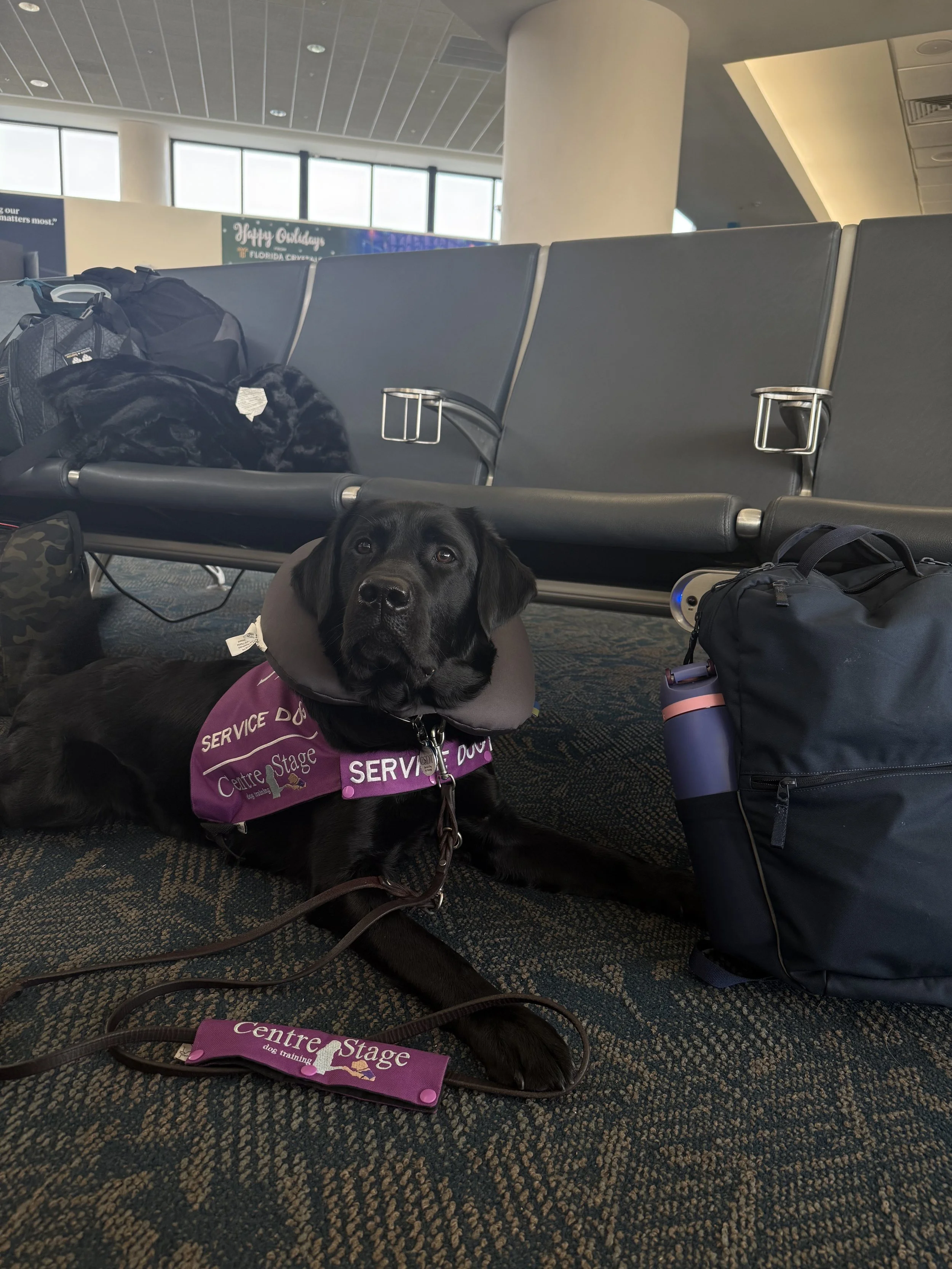
Image Description: Black lab lays on a dark carpeted floor in front of gate seats in an airport. He wears a purple service dog vest that says Service Dog | Centre Stage Dog Training. To his right is a navy backpack with a purple water bottle in it. He has a grey neck pillow around his neck
Considering Flying with Your Service Dog?
Flying with a service dog is often a very liberating experience for many handlers and gives them the ability to travel independently. These trips are often shown in a highlight reel on social media: a perfectly tucked dog, calm airport navigation, a peaceful nap at 30,000 feet, and arriving at your destination. What it doesn’t show is the planning, the practice, the access challenges, and the logistics required to get there.
As a professional service dog trainer, I help many of my teams prepare for flying, so let’s talk about how you can set yourself and your dog up for success long before you need to travel with them!
Prepare for the Environment BEFORE the Flight!
Airports are overwhelming, for people and dogs. They’re loud, crowded, unpredictable, and full of movement. One of the biggest challenges I find is that traveling with a service dog requires lots of split attention on the handler's side. Think of all the logistics of traveling, now add a dog to that!
Before you ever book a flight, your service dog should be comfortable working in environments that mirror those challenges, including but not limited to:
Busy stores with carts, people, and noises
Navigating and/or tucking into tight spaces
Ignoring items on the ground
Long periods of waiting with minimal or no interaction from the handler
Navigating crowds without forging or lagging
Practicing outings where the handler is distracted for varying amounts of time, this may mean you are unable to give your dog feedback or reward them at times!
People, children, and dogs at varying distances
If your dog struggles in these settings, the airplane itself isn’t the next step — more foundation work is and I highly recommend working with a trainer to assess if and when your dog may be ready for this challenge!
Settling is a skill- and an important one!
A lot of service dog work, especially on travel days, is hurry up and wait! One of the most overlooked flight skills is the ability to comfortably settle for long periods of time in different environments. Before considering traveling with your service dog, it is important to ensure they are comfortable:
Settling in tight spaces
Settling for extended periods of time (flight + airport + possible delays, etc.)
Remaining neutral and well-behaved when bored
Able to remain tucked without excessive repositioning or needing to take up multiple seats
Practicing long duration settling at home, in public, and during outings builds the emotional endurance required for flights. To settle for long periods in novel environments, your dog needs to be comfortable and have a strong reinforcement history!
Trainer tip: make a fake airline row out of several seats! Line up three seats next to each other side by side, directly in front of and behind them line up three more seats to create rows. Practice having your dog tuck into the aisle and seat and settle at your feet as if you are on a plane!
Spatial Awareness and Surface Confidence!
When traveling your dog will experience tight spaces, being stepped over or touched unexpectedly, navigating narrow aisles, and walking over different gaps, floors, and sensations.
Preparation includes intentional handling work such as:
Teaching your dog to tuck into tight and novel situations
Being comfortable on different surfaces, including pottying on cue for pet relief areas
Being touched by strangers to prepare for TSA
Being able to easily and quickly change positioning on cue
Trainer tip: I often recommend my teams train at an arcade to practice with different underfootings, sounds, lights, and tight spaces!
Logistics: Always Expect the Unexpected!
Not only do you need to have yourself ready to travel, but you also need to account for packing for your dog, ensuring you have any necessary paperwork for the airline or location you’re traveling to, and having their needs met before the flight. It certainly isn’t just a “wake up and go” scenario!
Even the best-prepared teams encounter surprises:
Delays
Gate changes
Curious (or intrusive) strangers
Airline staff with varying levels of knowledge that may present challenges
Part of preparation is the handler mindset. Having a plan — and a backup plan — reduces stress for both ends of the leash. Carry necessary forms, know your rights and have resources to support them, and remember that proactive training, for dogs and humans, leads to the most successful trips!
The Reality of Traveling with a Service Dog
We can’t plan everything perfectly, the key is to being prepared! This alone is why it requires a stable, confident dog to handle traveling. Even when the unexpected happens, for both the dog and handler welfare, service dogs should be able to:
Recover quickly and easily from unexpected situations
Perform tasks reliably and effectively
Remain neutral and responsive to their handler
Even humans need some recovery time from travel, be sure to build in decompression time for your pup once you arrive! Travel days are long, your pup needs to rest and recoup afterwards.
If you are concerned any of these components may cause distress or uncertain behaviors from your dog, that’s information! Contact a trainer to ensure you are practicing the best decision making for your dog, and service dog teams as a whole.
Preparation Is Ongoing
Flying once doesn’t mean your dog is “flight ready forever.” Skills need to be maintained, refreshed, and expectations adjusted as your dog matures or circumstances change.
Flying with a service dog is a line to independence and a responsibility — one that requires thoughtful training, honest assessment, and compassion for the dog working beside you.
Because the goal isn’t to have a “picture-perfect flight”. It’s a safe, respectful, well-supported team — on the ground and in the air.
Need help training your service dog, creating a checklist, or assessing if they’re ready for travel? Email me at contact@centrestagedogtraining.com.