
Not Every Dog Should be a Service Dog: Here’s What it Really Takes
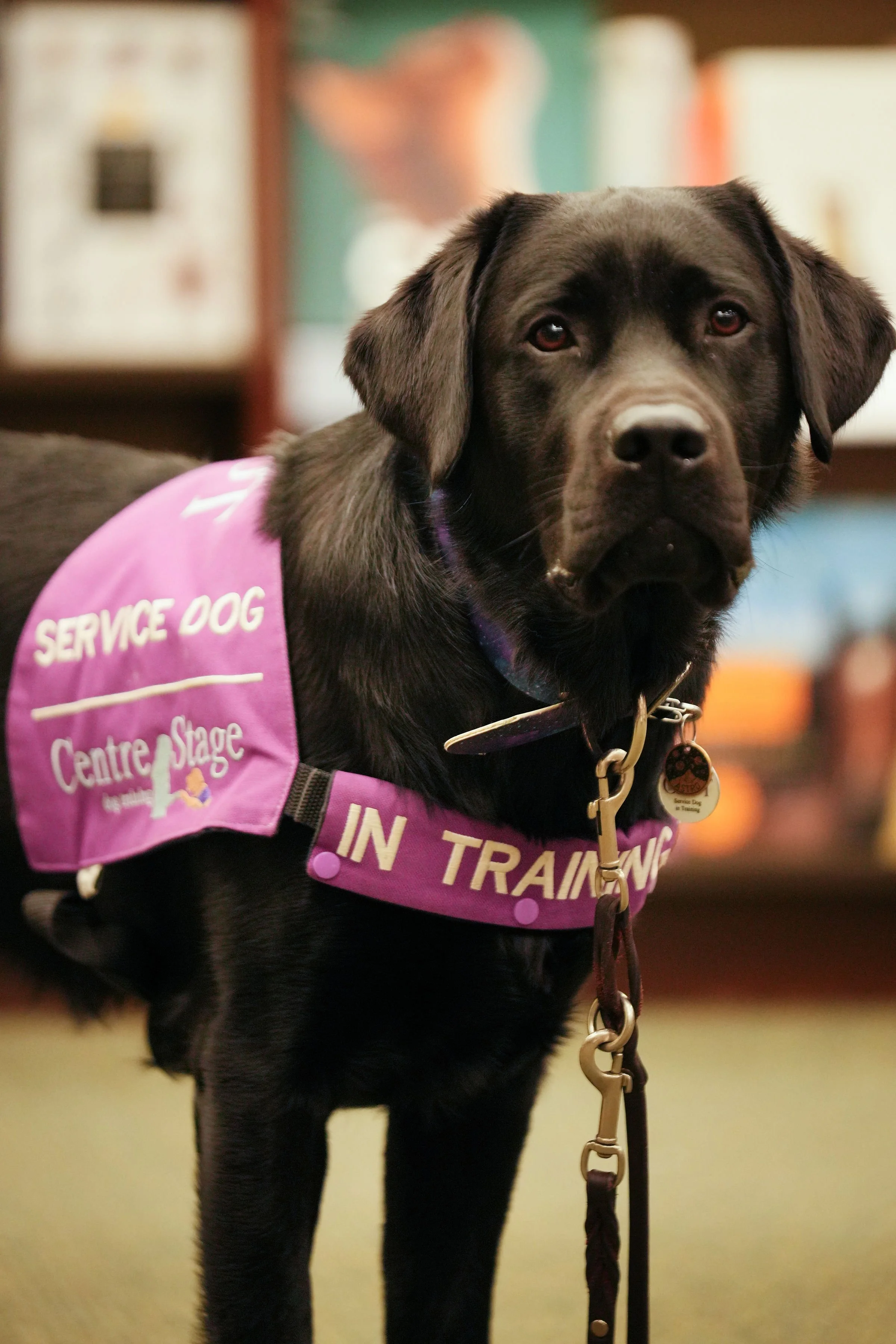
Image Description: Head shot of a black lab looking at the camera. He wears a purple vest that says “Service Dog” and “Centre Stage Dog Training” the chest wrap reads “in training”. The dog wears a purple starry collar and he has a nickel leash clip clipped to the collar.
Not Every Dog Should be a Service Dog: Here’s What it Really Takes
Social media is full of impressive videos showing dogs alerting to medical conditions, guiding their handlers through busy spaces, or calmly accompanying their person everywhere they go. These incredible stories and videos have brought more attention than ever to service dogs.
While that visibility has helped many people learn about the life-changing impact a service dog can have and increase their reach to support individuals, it has also created a common misunderstanding that any dog can be a service dog with enough training.
The truth is, not every dog is suited to be a service dog, just like not every person is suited to be a doctor. In reality, the vast majority of dogs, even the most wonderful, well trained ones, are not the right fit for service work- and that’s okay!
Service dogs are not just highly trained pets. They are working animals with an extremely specific, high level set of skills, temperament traits, and resilience that allows them to support their handler in nearly every environment. So what does it actually take to be a service dog? Let’s talk about it!
Service Dogs Need the Right Temperament
One of the most important factors in a successful service dog isn’t training — it’s their baseline, natural temperament. Training plays a large role, but the dog’s natural reactions and recovery are a must.
A service dog must be able to navigate the world calmly and confidently, remaining focused on their handler and tasks, often in environments that are overwhelming, unpredictable, and even unnatural. While we hope that the public respects service dogs, it is extremely common for a service dog to be approached or rushed by a child, adult, or dog while working. It is essential that the service dog is able to remain calm, safe, and be easily refocused.
Think about some of the situations a service dog may encounter:
Crowded stores
Busy airports
Loud restaurants, with the potential of food on the ground to be ignored
Medical offices
Public transportation
Children and dogs running toward or touching them
Sudden movements, sounds, and sights
And so much more! A suitable service dog needs to be confident, stable, resilient, and environmentally neutral in these spaces. They cannot be easily startled, reactive, fearful, or overwhelmed. These dogs need to be easy to manage for their handler and unobtrusive to the public, regardless of the environment.
Even dogs who are wonderful family companions, or enter training with goals of being a service dog, may struggle in these situations — this is part of what makes it so selective.
Public Access Is a Huge Part of the Job
One of the biggest differences between a well-trained pet, emotional support animal, or even a therapy dog and a service dog is public access reliability.
Service dogs must behave appropriately in public 100% of the time. This includes:
Settling quietly for long periods- service dogs spend much of their working day laying calmly out of the way while their handler is at work, appointments, or leisure activities
Ignoring food, people, and other animals, even if they try to distract them- service dogs should not lunge toward, vocalize at, or try to engage with the public, items, or other dogs
Walking calmly through crowds and being comfortable doing so
Remaining neutral around distractions and unexpected events- they should be comfortable around loud sounds, sudden distractions, and recover quickly and easily from startling events
Maintaining focus on their handler
Ability to perform tasks that pertain to the handler’s disability in a variety of situations
Even small behavioral challenges, that may seem minor for a pet, can make public access unsafe or disruptive for both the public, the handler, and other working teams.
For example, behaviors such as:
Barking at other dogs
Pulling toward people for attention
Struggling to settle
Anxiety, fear, or overarousal in busy environments
These behaviors may be manageable in a pet home, but they are not compatible with the expectations placed on service dogs. While a lot of focus and the ability to ignore distractions is worked on through training, the dog’s baseline stability and resilience play a large role in their ability to handle novel environments and unpredictability.
Service Dogs Must Enjoy the Work
Something that often gets overlooked is this: Service dogs should enjoy their job. The right dog for service work tends to be naturally engaged with their handler, motivated to work through food rewards, and comfortable accompanying their person everywhere.
A dog who prefers quiet environments, struggles with stimulation, or shows stress in busy settings is telling us something important: this job may not be the right fit for them. Listening to the dog’s wellbeing and preferences is a critical part of ethical service dog training.
Training Is Extensive — It Takes Time, a Lot of Time
Even with the right temperament, becoming a service dog requires an enormous amount of training and patience. Most service dogs train for 18–24 months before being fully placed or considered reliable for full-time work, and even then training is never over.
In short, this training includes socialization, reliable obedience, public access skills, task training for the handler, and any skills that may be specific to the lifestyle of the handler or the type of work the dog will be doing. During this 1.5 to 2 year process, it is not uncommon for dogs to be “career-changed” or released from service work. While this is an incredibly hard decision to make, it is a normal and ethical part of training programs. Listening to the dog and making sure they are sound and suitable for this type of work is essential for their welfare and for general public access.
During this process, many dogs are career-changed (released from service work) if they show that the job is not the right fit for them. This is normal — and it’s part of responsible training programs.
Ethical Service Dog Training Means Putting the Dog First
A responsible service dog program evaluates dogs carefully and prioritizes their welfare throughout the training process. There is no one evaluation that can predict if a dog will graduate as a service dog, instead it requires careful evaluation and progress checks throughout training.
This means recognizing when a dog is not suited for the work and allowing them to pursue a life that better fits them. While this is an incredibly difficult decision, it is essential to the longevity and ethics of the team. This could be a career change to another working career such as a facility dog, therapy dog, or detection dog, or may be enjoying the pet life.
The goal is not just to create a working dog — it’s to create a healthy partnership between a handler and a dog who genuinely thrives in the role. If you are considering a service dog, working with an experienced trainer or program can help evaluate whether a dog is a good candidate and guide you through the training process.
Service dogs are truly incredible partners — but the best ones are the dogs who are naturally suited to the job.
Thinking About a Service Dog?
If you’re considering a service dog, the first step is understanding what the process truly involves — from selecting the right candidate to the extensive training required for public access and task work.
Working with an experienced trainer or program can help you determine:
Whether a service dog is the right fit for your needs
Whether your current dog may be a suitable candidate
Whether owner training or a program trained dog suits you best
What the training process realistically looks like
What to expect from life with a working dog
Service dogs are life-changing partners for the people who need them. At Centre Stage Dog Training, we feel strongly that the best partnerships happen when both the handler and the dog are set up for success in their roles.
If you’re interested in learning more about service dog training or exploring whether a dog may be a good candidate, you can learn more about our programs at Centre Stage Dog Training or reach out to contact@centrestagedogtraining to learn more.